This means that the slope of $\ln x$ at $(x,\ln x)$ is $1/x$The natural logarithm of a number is its logarithm to the base of the mathematical constant e, which is an irrational and transcendental number approximately equal to 2718 281 8 459The natural logarithm of x is generally written as ln x, log e x, or sometimes, if the base e is implicit, simply log x Parentheses are sometimes added for clarity, giving ln(x), log e (x), or log(x) The derivative of ln x is 1/x Replacing the expression, that gives you 1 / (1x) By the chain rule, this must then be multiplied by the derivative of (1x), which is 1
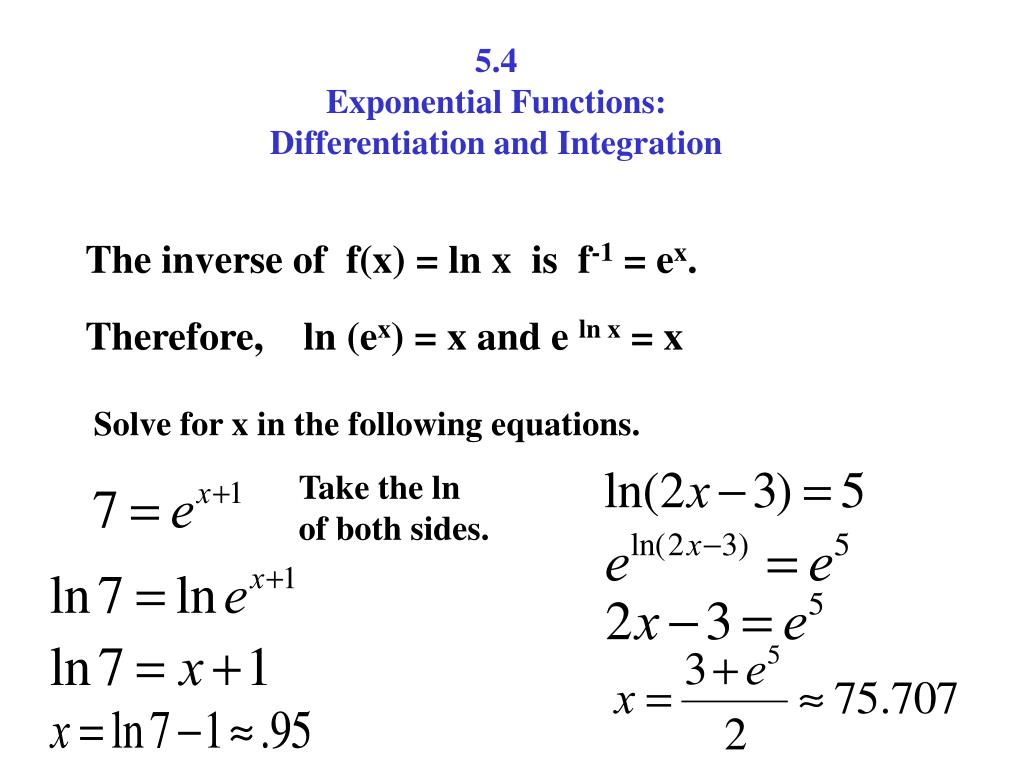
Ppt 5 4 Exponential Functions Differentiation And Integration Powerpoint Presentation Id

